
Computer and Electronics Recycling Drop-off in the San Francisco Bay Area
Since 2005, we’ve serviced 414,161 individual customers and recycled over 34,006,783 pounds of electronics.
Monday to Friday, 10 AM to 6 PM at 1831 Old Bayshore Hwy, Suite 2, Burlingame, CA 94010, near SFO. No appointment is necessary—convenient drive-thru drop-off service. (Closed on Major Holidays)




No appointment is needed for drop-off recycling. Just come to our Burlingame EcoCenter to recycle your computers and electronics.
What Items Can Be Recycled/Dropped-off at GreenCitizen EcoCenter?
If it has a plug, a battery, or a circuit board, it counts as e-waste, and we most likely take it. Everything we accept and every price we charge is on this one list — we weigh and quote your fee-based items before we process anything, so there are no surprises.
Accepted Items and Pricing
Free to Recycle
Peripherals & appliances
- Appliances
- DVD/CD Players & VCRs
- Fans
- Printers & Fax Machines
- Scanners
- Heaters
- Keyboards
- Speakers
- Cables
- Misc. Electronics
Tapes, discs & film
- CDs
- Cassette Tapes
- Vinyl Recycling
- DVDs
- Floppy Disks
- VHS Tapes
- 35 mm Slides
- DLT/LTO
- Film Negatives
Other items & services
- Data erasure $5/drive
- Physical drive destruction $20/drive
- Tape destruction $20/unit
- Phone & tablet destruction $35/device
- #6 Styrofoam (EPS only) $5/30-gal bag
- Refrigerator, full size $130
- Refrigerator, mini $65
**If you are unsure about anything, it’s a good idea to call us and confirm.
What We Cannot Accept
These items are refused at the window, so please don’t make the drive with them. Our Green Directory will find you a verified drop-off site near your ZIP code for anything on this list.
Hazardous items
Regulated separately under California law.
- Loose batteries not installed in a device — alkaline, lithium, carbon zinc, UPS batteries
- Light bulbs — incandescent, CFL and fluorescent
- Smoke detectors: models that contain americium 241
- Anything with liquid mercury — thermometers, thermostats
- Paint, motor oil, sharps and biohazardous waste
Non-electronic and oversized
Try your city bulky-item pickup instead.
- Large appliances — stoves, washers, dryers
- Furniture, chairs and couches
- Styrofoam #4 LDPE foam and polyurethane
- Bottles, cans and household recycling
What Our San Francisco Bay Area Customers Say

I love that there is a place to recycle electronic items responsibly. No overseas shipments; all are disassembled here and taken care of in an environmentally sound way. The small price they charge is totally worth the environmental impact. It’s not realistic to think there is no cost for safe disposal. Very helpful staff, easy to drive in, safe and fast. I appreciate the data destruction option, too.
The staff at Green Citizen were incredibly informative, helpful and courteous.The process of dropping off computers and hard drives for destruction was so quick and simple. They have an efficient set up. I highly recommend them and I will definitely be going back to them when I have additional items to recycle. It’s an impressive organization.
Green Citizen makes electronics drop-off easy and friendly. We’ve been taking our stuff there for years. Best of all, I have confidence that they handle everything appropriately and responsibly. I’m happy to pay to dispose of things like old video tapes with them because I know how they will treat my discards – with as little environmental impact as possible.
Awesome experience!!! Had an old CRT-TV that I needed to get rid of. Pulled up and they came to the car and pulled it out. Friendly and helpful! Will definitely bring all ewaste to Green Citizen in the future.
Been here multiple times for home and small business. So easy and simple to fill out the form and drop-off isn’t DIY, they come out to your car and take care of everything! Always recommended and candidly, better than my local Scavenger.
Great recycling service. Their fees are very fair, and their service is stellar. I’ve gone multiple times over the last 8 years and have always had great, kind, helpful service. I really appreciate this company that does so much good with recyclables that would normally be added to landfill.
Green Citizen makes electronics drop-off easy and friendly. We’ve been taking our stuff there for years. Best of all, I have confidence that they handle everything appropriately and responsibly. I’m happy to pay to dispose of things like old video tapes with them because I know how they will treat my discards – with as little environmental impact as possible.
I’ve been to GreenCitizen a few times now to drop off old electronics and cables. They’ve been wonderful every time. You simply pull up in your car, someone will come out to help process your drop off. Every time has been less than 10 minutes and very pleasant customer service. Safe, quick, efficient, no hassle. Wonderful.
What Is GreenCitizen’s Drop-Off Recycling Service?
GreenCitizen runs a drop-off electronics recycling center at 1831 Old Bayshore Hwy, Suite 2, Burlingame, CA 94010, near SFO. It is open Monday through Friday, 10 AM to 6 PM, and no appointment is needed. Computers, laptops, servers, monitors, TVs, and phones are free to recycle. Peripherals such as printers and cables cost $1.00 per pound. Media such as VHS tapes, CDs, and floppy disks cost $6.00 per pound.
Pull into the loading zone, and one of our team members helps you with the process. We sort your items, tell you the cost before we process anything, and you’re back on the road.
Everything is recycled in the United States. Nothing is shipped overseas, and nothing goes to landfill. Anything with a hard drive is logged into AI-powered GreenCitizen Total Accountability Management System (AGTAMS), our proprietary tracking system, so there is a record of what happened to your device.
Find Our Burlingame Drop-Off Center
GreenCitizen EcoCenter
1831 Old Bayshore Hwy, Suite 2
Burlingame, CA 94010
Drive-thru entrance via Cowan Rd · 2 minutes from SFO
Drop-off hours
Monday – Friday, 10:00 AM – 6:00 PM
Closed Saturday, Sunday and major holidays
Phone
AGTAMS: Every Device Gets a Record — Not Just a Bin
At most drop-off programs your laptop goes into a mixed pallet and that is the last anyone knows of it. Here, anything with storage is logged individually into AGTAMS — our AI-powered GreenCitizen Total Accountability Management System — the moment it comes off your car.
That record follows the device through sanitization, refurbishment or teardown, so if you ever need to prove what happened to a specific drive, the answer exists. You can ask for a Certificate of Destruction or chain-of-custody documentation.
Data Security: Wipe or Destroy Your Hard Drive
Deleting files doesn’t remove them. Neither does a factory reset on most drives. If a computer, phone or drive held anything you’d rather a stranger not read, have it wiped or destroyed before it leaves your hands.
We use the same methods on your laptop that we use for our enterprise clients — the procedures specified in DoD 5220.22-M and NIST SP 800-88 Rev. 1.
Erase the drive
Software sanitization that leaves the drive working, so it can be refurbished and reused. Choose this if the drive still functions and you’d rather see it get a second life than be shredded. If a drive can’t be erased to standard, we upgrade it to physical destruction at no extra charge.
Destroy the drive
The drive is physically crushed or shredded on site and nothing on it is ever recoverable. Choose this if the drive is dead, if it held financial, medical or client records, or if you simply want to watch it happen. You’re welcome to witness the destruction.
Phones and tablets with soldered storage are destroyed for $35 per device, and backup tapes for $20 per unit. A Certificate of Destruction listing serial numbers and method is $5 per unit on any of these — see the full price list above.
Before You Drive Over
None of this is mandatory except the device locks — but doing it first is the difference between a five-minute visit and a twenty-minute one.
-
1
Bringing a computer or a TV? Fill out the form first. Submit the drop-off form online before you leave, then give us your name we’ll pull it up. If you’re only bringing small items like cables or a toaster, skip it — no form needed.
-
2
Remove your device locks. Sign out of Apple Account/ID/iCloud, and clear any BIOS/EFI, Activation Lock, DEP or MDM enrollment. A locked device can’t be wiped or reused, so it goes straight to physical destruction instead.
-
3
Sort your free items from your fee items. Two boxes is enough — one for computers, screens and phones, one for everything that gets weighed. It speeds up intake considerably.
-
4
Bring a card if you have fee items. We take Visa, Mastercard, American Express, Discover, JCB and UnionPay, plus Apple Pay, Google Pay and Samsung Pay.
How Drop-Off Recycling Works
Pull into the loading zone
Take the Millbrae exit off Highway 101 onto Old Bayshore Hwy. Our center is at the back of the building — turn onto Cowan Rd to reach it. Park in the marked loading zone out front for heavy items like TVs, towers and printers.
We unload, sort and quote
Our team takes care of everything; sorts it on the spot into free items and fee items. Anything billable gets weighed in front of you and we confirm the total before we process anything. If a price isn’t what you expected, you can take the item back.
Pay and go
Tap or swipe your card and you’re done — you’ll get a receipt on the spot. Every device with storage is logged into AGTAMS before it moves. Need a formal Certificate of Destruction or chain-of-custody paperwork? Ask us and we’ll arrange it for a price.
Why Drop Off Here Instead of a Big Box Store or County Event
Free e-waste collection exists elsewhere in the Bay Area. Here is what actually differs once your device is out of your hands.
| GreenCitizen Drop-Off | Big box stores & county programs | |
|---|---|---|
| Where it ends up | Processed in the U.S. | Usually handed to a third-party aggregator. The trail ends there. |
| Your data | Wiped or physically destroyed on request, to DoD and NIST methods. | No stated handling. Your drive travels intact. |
| Tracking | Every item with storage logged individually in AGTAMS. | Tossed into a mixed bin. No item-level record exists. |
| What’s accepted | CRTs, VHS, cassettes, floppies, #6 Styrofoam, microwaves, mini-fridges. | Commonly refused. Media and foam go to landfill. |
| Heavy lifting | We unload your car. You never carry a CRT across a parking lot. | Carry it in yourself, often to a service desk at the back. |
| Wait | Under 10 minutes, five days a week, no appointment. | Counter queues, or a county event held twice a year. |
Bay Area Cities We Serve From Our Burlingame EcoCenter
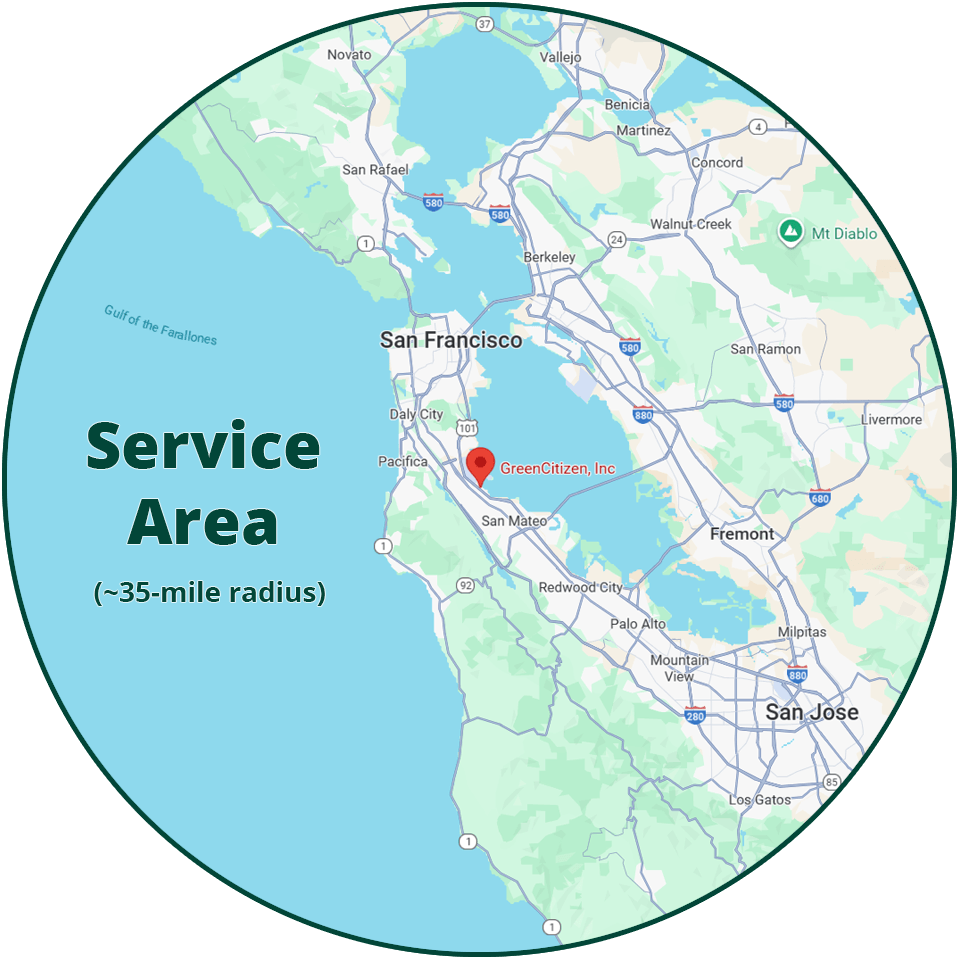
We’re at 1831 Old Bayshore Hwy, directly off Highway 101 near SFO — central to San Mateo County and within an easy drive of most of the Peninsula and the western Bay. Rough drive times, outside rush hour:
Burlingame · Millbrae · San Bruno · South San Francisco · Hillsborough · San Mateo · Foster City
Daly City · Belmont · San Carlos · Redwood City · Brisbane · Pacifica · Half Moon Bay · Atherton
San Francisco · Palo Alto · Menlo Park · Mountain View · Fremont · Hayward · Union City · San Leandro
Oakland · Berkeley · San Jose · Sunnyvale · Santa Clara · San Ramon · Walnut Creek · Richmond
Coming from the East Bay, South Bay, or outside the Bay Area entirely? Our Mail-In Recycling Service covers the whole USA.
FAQ
No appointment is necessary. Just come to our EcoCenter in Burlingame during business hours. Pull into our designated loading zone, and our team will help you with intake.
If you are recycling a television or computer, please fill out the drop-off form before arrival and submit it online. When you arrive, let our team know your name so we can confirm your submission quickly. If you are dropping off miscellaneous items only (for example, cables or small appliances), you do not need to submit the form.
We are located at 1831 Old Bayshore Hwy, Suite 2, Burlingame, CA 94010. We are conveniently located near SFO (San Francisco International Airport), serving residents across the entire San Francisco Bay Area.
We’re open Monday through Friday, 10:00 AM to 6:00 PM. We’re closed on weekends and major holidays. (If you’re visiting around a holiday, it’s a good idea to check for closure notices before you drive over.)
Most drop-offs are completed in under 10 minutes. Our team sorts your items immediately upon arrival so you can pay any applicable fees and be on your way.
We offer free recycling for high-value IT equipment, including:
- Computers: Desktops, Laptops, Servers.
- Displays: LCD/LED Monitors, CRT Monitors, and Televisions (All types).
- Mobile: Cell Phones, Tablets, and Smartphones.
Networking: Switches, Routers, and Modems.
The $1.00 per lb cost applies to peripheral and consumer electronics, such as:
- Printers, Scanners, and Fax Machines.
- Keyboards, Mice, Cables, and Chargers.
- Stereo Equipment (Speakers, VCR/DVD Players).
- Small Appliances (Fans, Heaters, Microwaves).
Magnetic and optical media are difficult to process and cost $6.00 per pound to recycle. This includes VHS tapes, cassette tapes, floppy disks, CDs, DVDs, vinyl records, and film negatives. This fee helps offset the special handling, transportation, and destruction/incineration costs required for these materials.
Yes, but clean, white block Styrofoam (#6 EPS) only. The fee is $5.00 per 30-gallon bag. We cannot accept #4 Styrofoam, LDPE foam, dirty/contaminated foam, or mixed foam packaging.
We offer two tiers of security for hard drives:
- Physical Destruction ($20/drive): The drive is crushed/shredded.
- Data Erasure ($5/drive): Software-based wiping for functional drives.
Note: A formal Certificate of Destruction is available for an additional $5/unit.
Yes. Mobile devices with non-removable storage can be physically destroyed for $35 per device.
Yes. Our data sanitization and data destruction methods are the same as those specified by DoD 5220.22-M and NIST SP 800-88 Rev. 1, ensuring corporate-grade security for personal devices.
Yes, every item that we receive is tracked and logged in to our AGTAMS (AI-Powered GreenCitizen Total Accountability Management System) to create a traceable record.
No. We cannot accept loose batteries (Alkaline/Lithium), light bulbs (CFL/Fluorescent), or smoke detectors due to hazardous material regulations.
Please visit our Green Directory to find a verified local drop-off location near you for batteries, paint, and household hazardous waste. To get the best match quickly, simply enter your ZIP code and the item you want to recycle.
We accept small appliances (microwaves, mini-fridges) for a fee, but we cannot accept large appliances like washing machines, dryers, or full-sized stoves.